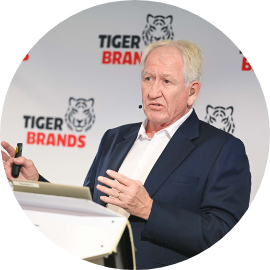
Tjaart Kruger
CEO Tiger Brands
R1.5 billion
planned investment over the next three years, with annual investment peaking at about R2 billion
4.5%
normalised volumes growth for the six months to March 2026
~19 000
tonnes of small white beans a year from local farmers for production of KOO Baked Beans
Investing in Tiger Brands, investing in South Africa
“
The purpose of investment is not to predict every disruption, it is to build a business that can respond when disruption comes: factories that run more efficiently, supply chains less exposed to single points of failure, better data for faster decisions, and, above all, people with the skills to keep improving how we work.
There is never a perfect time to invest.
When the economy is strong, capacity is expensive and hard to secure. When conditions are difficult, the instinct is to wait for greater certainty. But in business, certainty usually arrives too late to act on.
Companies everywhere are now operating with trade disruption, shifting tariffs, geopolitical tension and supply chains that are harder to predict. These are no longer isolated shocks. They have become part of the environment itself. Across manufacturing, that uncertainty is prompting many companies to defer investment, optimise existing capacity or rethink parts of their footprint. Those are rational responses. We have made a different choice.
South Africa carries its own pressures. Our economy is growing, but too slowly to move the numbers that matter most: unemployment and household security. Consumers are careful about what they buy, where they buy it and how much goes into each basket.
For a food company, that reality sits at the centre of every decision we make.
Consumers are not simply chasing the lowest price. They are looking for products worth what they pay, on quality, taste, convenience and trust. Global research shows that value-seeking has become a durable behaviour, extending well into higher-income households. In South Africa, affordability and price have become significant drivers of brand choice.
That changes how we think about investment.
Affordability cannot be created only at the shelf. It has to be built into the whole value chain, into how efficiently we buy ingredients, how much energy and water we use, how much we waste, how reliably our factories run, how far products travel, and how quickly we respond when consumer needs shift.
A more efficient factory gives us more than capacity. It reduces waste, improves consistency, secures supply, protects quality and lets us bring relevant innovation to market faster. A stronger distribution network does more than move cases; it improves availability, sharpens service and gets the right products to the right outlets at the right time.
This is why investment and affordability are inseparable.
When we set out to reshape Tiger Brands, we knew there was no quick fix. We had to strengthen the fundamentals first, simplifying the portfolio, making clearer choices about where we can create the most value, changing our operating model and sharpening our focus on cost, quality and execution. Much of that work was invisible to consumers. All of it was necessary.
Our latest results suggest it is taking hold. For the six months to March 2026, normalised volumes grew 4.5%, gross margin improved, and every business unit lifted operating income. Eight of our 14 focus brands gained both value and volume share over the preceding year.
Those results are not the destination. They are what gives us the confidence, and the means, to invest in the next phase.
Tiger Brands plans to invest around R1.5 billion a year over the next three years, with annual investment peaking at about R2 billion. We are directing that capital to the parts of the business that strengthen competitiveness, support growth and help us serve consumers better.
The first of these structural investments is already running.
In Paarl, we have invested more than R200 million to turn an historic facility into a modern culinary site. We have brought vinegar production in-house, moved the manufacture of Mrs Ball's Chutney into Tiger Brands, and installed new lines that let us pack jam in lighter, recyclable PET. Each element solves a practical need: producing our own vinegar reduces our reliance on outside supply of an ingredient used across several brands; bringing Mrs Ball's in-house tightens quality control and supply security; and the new packaging opens the way to more convenient formats and future innovation.
Other investments are following. In Pretoria, our R1 billion Albany Super Bakery is taking shape, with commissioning planned for 2027. In Gauteng, work is under way on a new mega distribution centre. In eThekwini, we are consolidating our Snacks & Treats manufacturing into a single site. And in Pietermaritzburg, we have completed the first major upgrade of our mill in its 33-year history, lifting extraction and cutting waste.
The scale of these projects matters less than what they are for. The real test is whether they make us more reliable, more productive and more responsive to the people who buy from us.
Strong brands do not survive on heritage alone.
Albany, Jungle, Tastic, KOO, All Gold and Oros have been part of South African life for generations. That history matters, but it guarantees nothing about tomorrow's basket. Consumers constantly reassess the value they get; they compare brands, packs, channels and prices, and they change what they eat and how they shop. Brands earn their place by delivering, consistently, and staying relevant to lives that keep changing. That takes investment in insight, quality, innovation and manufacturing flexibility, competing not only on price but on better formats, texture, flavour and functionality, and using the gains from productivity to fund what comes next.
It also takes resilience in the inputs our products depend on. For us, localisation is not a slogan; it is a way of strengthening supply security while backing South African farmers. At Paarl, agricultural inputs come from Western Cape growers. Across the business, we procure roughly 19 000 tonnes of small white beans a year from local farmers for products such as KOO Baked Beans, and we are working with emerging producers to make that supply base even stronger.
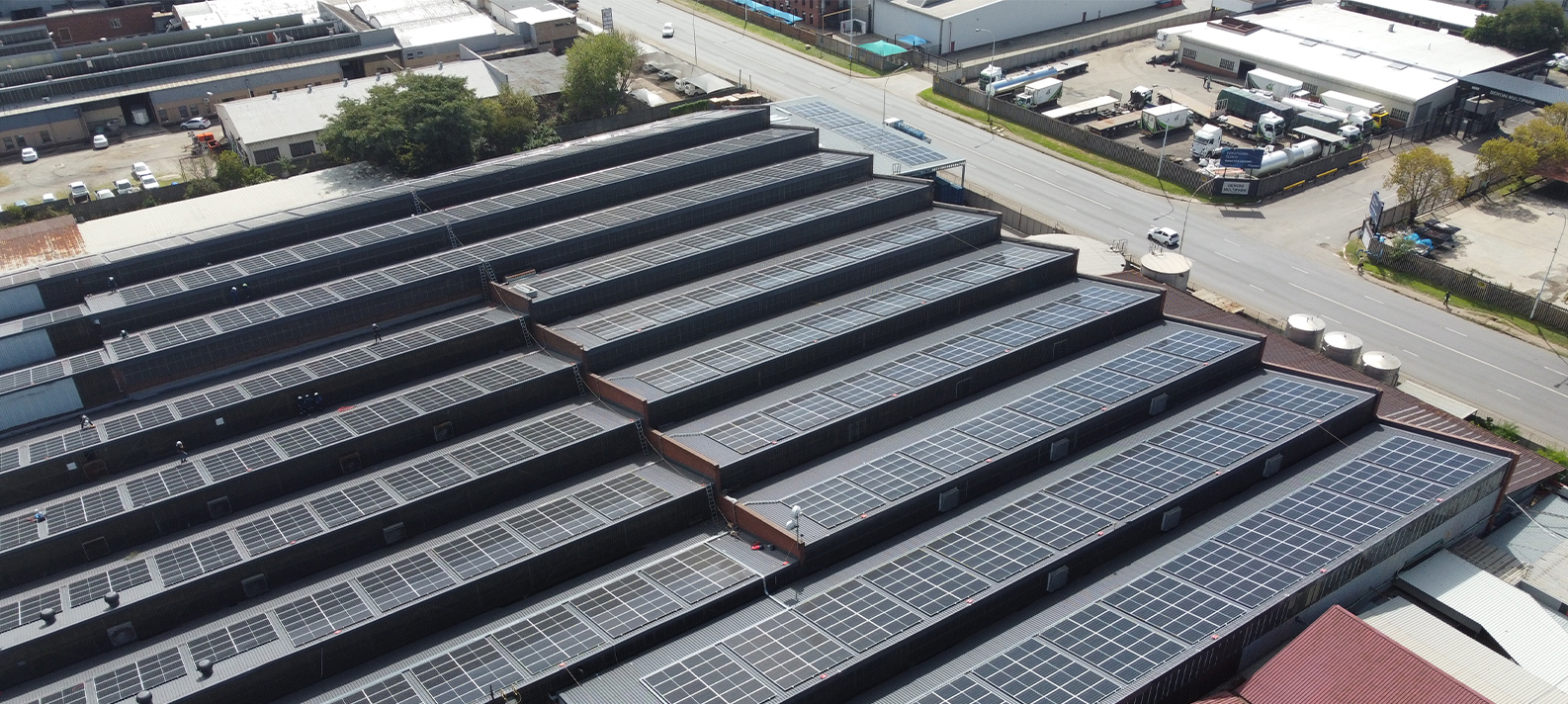
We are investing in energy and logistics resilience too. Solar generation now runs at seven of our manufacturing sites, and a new electricity-wheeling agreement is expected to supply participating Gauteng sites with a significant share of renewable power from 2028, reducing emissions while improving energy security and efficiency.
None of this removes uncertainty. Input costs will move. Trade relationships will shift. Climate will affect what our farmers can grow. Consumers will keep making hard choices. The purpose of investment is not to predict every disruption, it is to build a business that can respond when disruption comes: factories that run more efficiently, supply chains less exposed to single points of failure, better data for faster decisions, and, above all, people with the skills to keep improving how we work. New equipment only creates value when capable, committed people use it well, and the progress we have made so far has been theirs.
There will always be reasons to wait. We have chosen to move forward, with discipline, because we believe Tiger Brands can grow, because South Africa needs a strong and competitive manufacturing base, and because millions of people rely on everyday food that is available, trusted and affordable.
For more than a century, the Tiger Brands story has been part of South Africa's story. Our task now is to prepare both for the next chapter and to keep cultivating and nourishing lives every day and every tomorrow.
Accelerating the shift to renewable energy
Powering progress with cleaner energy
Tiger Brands is powering ahead with its shift to cleaner energy, with seven of our manufacturing sites now generating electricity from solar power.
"Solar energy is already helping several of our manufacturing facilities reduce their dependence on conventional electricity sources while improving operational efficiency. Importantly, this is just one component of a broader renewable energy strategy that will continue to evolve over the coming years."
The business also recently signed a renewable energy wheeling agreement with renewable energy supplier Apollo Africa that will see some of Tiger Brands’ Gauteng manufacturing sites receive around 60% of their electricity through wheeling from 2028.
“Wheeling allows our business to grow, maximise cost efficiency, all while reducing our carbon footprint. This is a clear example of how we are working across our value chain to bring the best value and affordable nutrition to consumers while reducing the impact of our operations on the environment.”
The initiatives will help reduce the company’s reliance on conventional electricity, improve operational efficiency and cut carbon emissions as Tiger Brands moves towards cleaner, more sustainable manufacturing.
"Our investment in renewable energy is about building a more resilient and sustainable manufacturing footprint while supporting South Africa's transition to a lower-carbon economy," says Praveen Balgobind, chief manufacturing officer at Tiger Brands.
Growing local, from farm to Oros
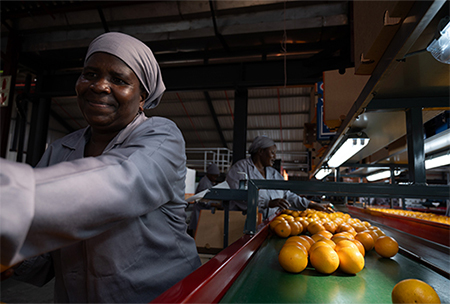
South African growers supply 100% of Tiger Brands' orange requirements for Oros for the second consecutive season
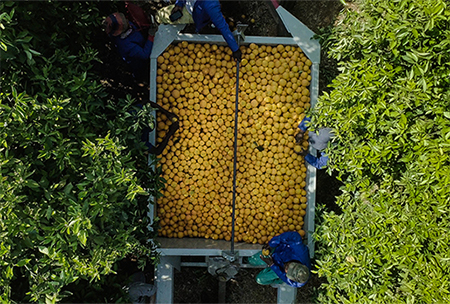
For the second consecutive citrus season, Tiger Brands has sourced 100% of the oranges used to produce Oros from South African growers.
This is a significant shift from previous years, when around 35% of our orange requirements had to be imported due to constraints on local supply.
Tiger Brands procures around 45 000 tonnes of oranges from local growers every year, providing stable domestic demand for farmers while reducing reliance on imports and strengthening South Africa’s agricultural supply chain.
"South African citrus is in high demand in a globally competitive market, making reliable local supply increasingly important. By sourcing 100% of our orange requirements from South African growers, we are reinforcing our commitment to local procurement, providing farmers with stable domestic demand, and strengthening South Africa's agricultural value chain while reducing reliance on imports," says Shamiel Randeree, managing director: Snacks, Treats and Beverages, Tiger Brands.
Multi-million rand site upgrade unveiled in Paarl
A new mega-site for quality you can trust
We have officially transformed our historic Paarl manufacturing facility into a cutting-edge mega-site with an investment of more than R200 million. Here is what that means for you:
- A new vinegar production plant strengthening supply for Mrs Ball’s, All Gold and Crosse & Blackwell — the condiments your family depends on
- Mrs Ball’s Chutney now made in-house, enhancing quality and supply security so you get the consistency you love every time
- South Africa’s first jam production lines transitioning to recyclable PET packaging — making your favourite jams more convenient while caring for our planet
It is an investment in the infrastructure that keeps your pantry stocked with quality, value and affordability.

Did You Know?
Oros has been part of South African families for over 125 years
275 million oranges go into making Oros each year
Oros supports farmers across three provinces: Mpumalanga, Limpopo and the Western Cape
R12 million
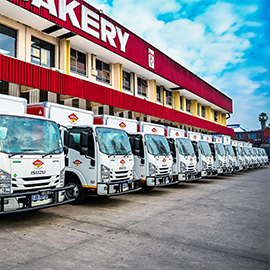
in 14 new compressed natural gas trucks
Tiger Brands moves to alternative fuel logistics
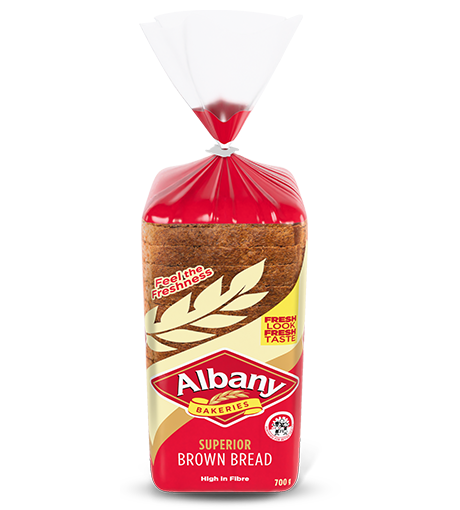
Tiger Brands introduces alternative-fuel logistics fleet for Albany bread deliveries
“
We expect the introduction of CNG vehicles to the Albany fleet to deliver meaningful benefits for the business and value for our consumers by lowering fuel costs, reducing exposure to diesel price volatility and improving fleet efficiency. At the same time, we are reducing our impact on the environment and caring for the communities in which we operate
Quinton Swart, managing director: Bakeries, Tiger Brands
Tiger Brands’ premium bread brand, Albany, is putting cleaner transport on the road with an investment of around R12 million in 14 new compressed natural gas trucks to deliver Albany bread from its Germiston Bakery in Gauteng.
The trucks offer a lower-emission, more cost-effective alternative to diesel, helping reduce fuel costs while improving the efficiency and resilience of bread deliveries.
And this is just the start. Tiger Brands plans to transition 10% of its fleet to alternative-fuel vehicles over the next five years. The Albany Super Bakery, currently under construction in Pretoria, will be the next Tiger Brands operation to receive a CNG fleet.
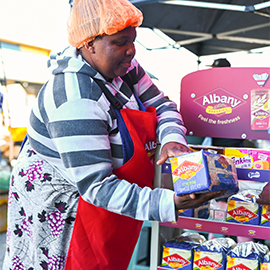
Bread-On-The-Streets offers entrepreneurial opportunities in local communities
Tiger Brands is taking Albany bread closer to consumers while creating income opportunities for entrepreneurs across South Africa.
More than 800 Albany Bread-On-The-Streets stands are already operating in busy community locations, with plans to grow the network to 3 000 stands within the next year. Each entrepreneur receives a branded stand and fresh bread delivered daily through Albany’s distribution network.
The initiative is helping individuals earn an income and gain practical business experience, while expanding Albany’s reach and making fresh bread more accessible in communities.
“Bread-On-The-Streets allows our Albany business to compete more effectively in a highly competitive local bread market, while bringing our product closer to consumers, ensuring accessibility and freshness. But in addition to expanding our route-to market, it’s making a contribution to our country’s unemployment rate, which has risen considerably over the past decade. The programme demonstrates how commercial growth and social impact can work together,” says Quinton Swart managing director: Bakeries, Tiger Brands.
Tiger Brands partners with leading universities to strengthen South Africa’s food security
“
South Africa needs a strong agricultural sector if we are going to produce enough to support food security, remain globally competitive and continue giving consumers access to quality, affordable food,” says Tiger Brands CEO Tjaart Kruger.
Growing the future of food. Nourishing more lives
Building a more food secure South Africa requires stronger local agriculture, practical innovation and collaboration across the food value chain.
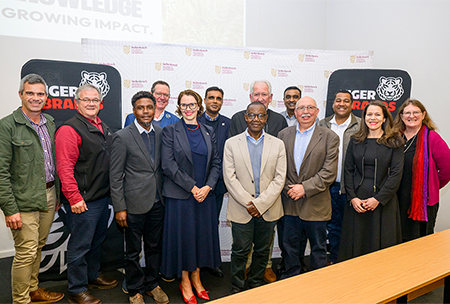
Tiger Brands has entered into strategic three-year partnerships with Stellenbosch University’s (SU) Faculty of AgriSciences and the University of the Free State’s (UFS) Faculty of Natural and Agricultural Sciences to help strengthen the resilience, productivity and competitiveness of South Africa’s agricultural and food system.
The partnerships bring together academic research and Tiger Brands’ experience across the food value chain to find practical, science-based solutions to some of the challenges affecting local food production, from climate change, water scarcity, pests and disease to crop yields, food safety and the economics of agricultural production.
For Tiger Brands, strengthening local agriculture is closely linked to both food security and the sustainability of its business. More than 90% of the company’s revenue in 2025 was derived from food and beverages, while 70% of its agricultural procurement spend was directed to local producers.
Research across the two partnerships will focus on important commodities including wheat, oats, sorghum, tomatoes, groundnuts and beans, as well as broader regenerative agricultural systems.
At UFS, the focus will be on improving areas such as germination, yields, crop quality, processing performance and sustainable agricultural practices, while strengthening the economics of the value chain.
The SU partnership will support research and practical innovation across three priority areas – agronomy, agricultural economics and food safety. It also builds on Tiger Brands’ longstanding collaboration with SU through the Centre for Food Safety.
Importantly, both partnerships look beyond immediate agricultural challenges. They are designed to strengthen collaboration between academia, farmers and industry while investing in postgraduate development, emerging researchers and the scientific and agricultural skills South Africa will need in the future.
“Building a more resilient food system requires us to think beyond today’s challenges and invest in the knowledge and partnerships that will secure future supply,” says Kruger.
“No organisation can solve the challenges of climate change and supply-chain competitiveness on its own. By bringing academic knowledge, commercial insight and agricultural expertise together, we can turn research into practical solutions that support local production and contribute to a more affordable and food-secure future.”
Zero waste to landfill
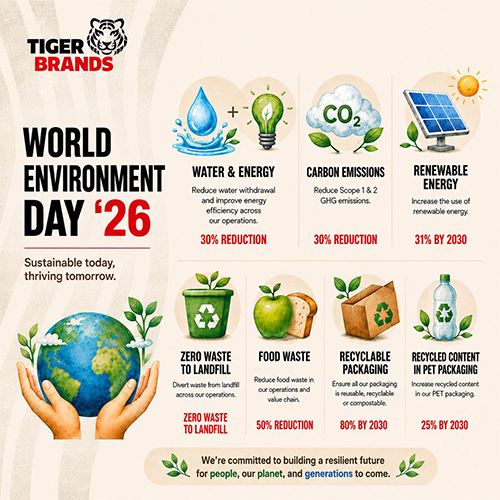
Three Tiger Brands manufacturing sites – Home and Personal Care (HPC) in Isando, Beverages in Roodekop and Jungle in Cape Town, have officially achieved Zero Waste to Landfill, a major step forward in Tiger Brands’ ambition to eliminate landfill waste across the group by 2030.
At HPC and Beverages, innovative waste recovery solutions and partnerships with A-Thermal helped eliminate landfill waste streams. At Jungle, teams found alternative uses for waste through initiatives such as composting, animal feed programmes and refuse-derived fuel solutions."
"This achievement demonstrates the power of innovation, collaboration and everyday actions. It also shows what is possible when our people unite behind a shared commitment to environmental stewardship,” says Praveen Balgobind, Chief Manufacturing Officer, Tiger Brands.
Had fun reading our newsletter?
Please let us know and click here
Follow us on our social media channels below for more stories.